Example deliverable

Sell Ticket Reduction Concentrated Position: Sample Pilot Outcome Report

A completed sell ticket reduction concentrated position report covers the transition analysis, trade recommendations, metric comparison, hard-constraint audit, and a short readout memo. This page describes what that looks like and includes a downloadable sample.

What a pilot delivers

Sample report: Single Mega Winner case

The lead example is a large single appreciated position under a $500K realized-gains budget transitioning into a benchmark-aware custom indexed portfolio. The sell ticket reduction concentrated position metric is one of the primary outputs.

Illustrative pilot outcome pack

Representative example deliverable — structure and depth of a completed pilot engagement.
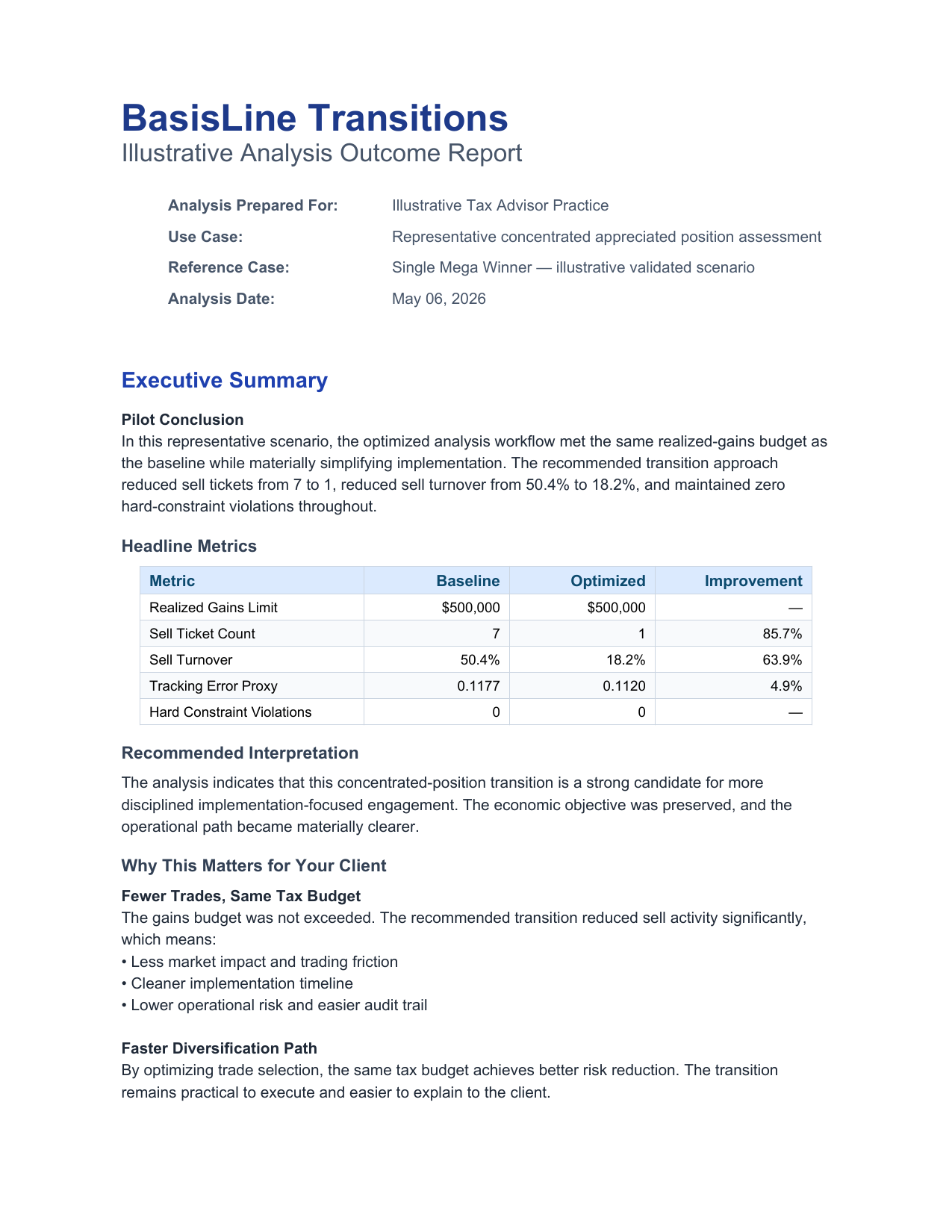
Sample pilot outcome report — cover page and executive summary
Cover & Executive Summary
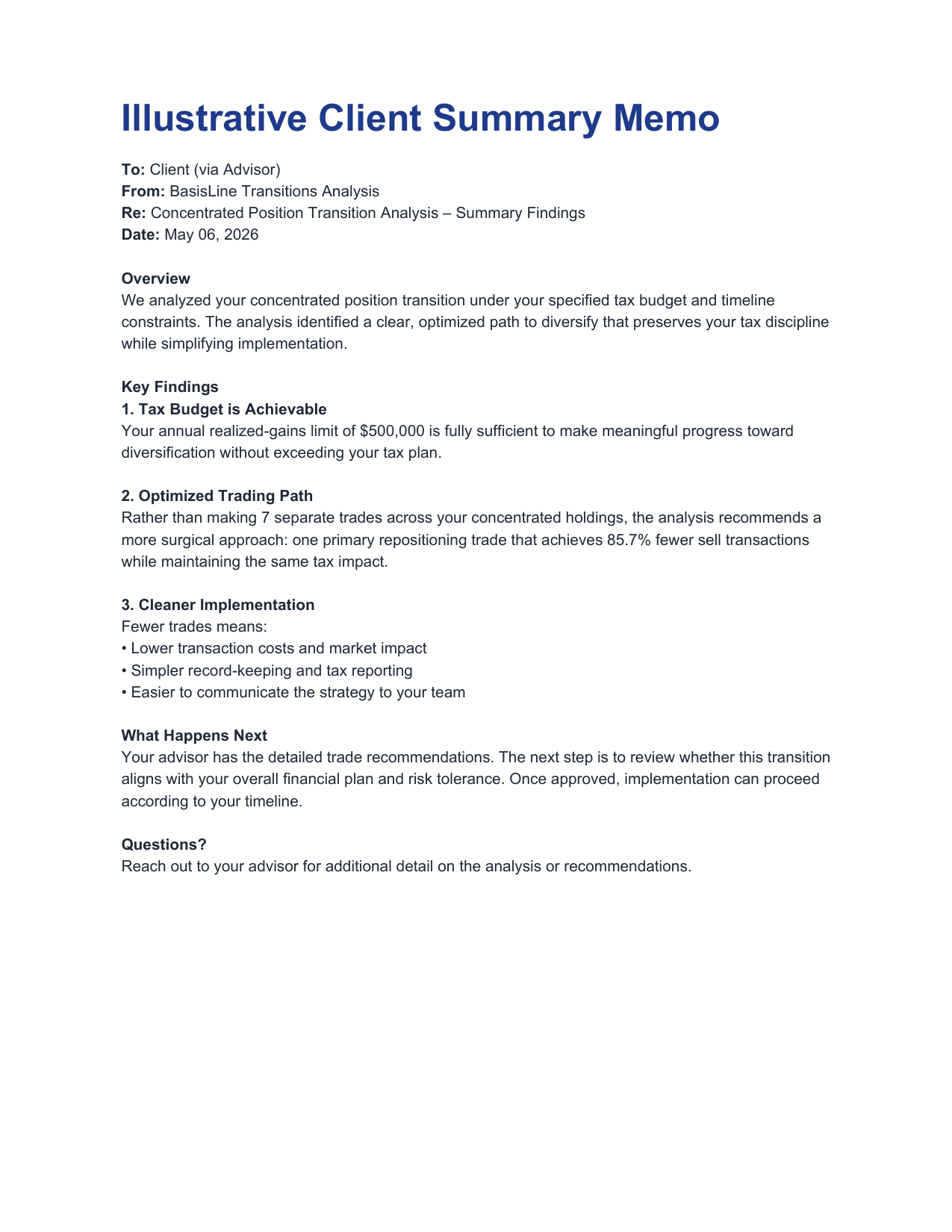
Sample pilot outcome report — illustrative pilot readout memo
Pilot Readout Memo
Pilot deliverables

What a completed pilot typically delivers

Each pilot is scoped to one concentrated-position transition problem. The deliverable is a self-contained report covering five components, including sell ticket reduction concentrated position analysis and metric comparison.

01

Transition analysis summary

Documents the portfolio problem, assumptions, and constraint setup — holdings, tax lots, gains budget, benchmark target, and implementation rules — so the evaluation basis is explicit.

02

Baseline versus optimized metric comparison

Side-by-side comparison under the same realized-gains budget and constraint set: TE proxy, sell ticket count, sell turnover, and realized gains for both the baseline heuristic and the constraint-aware workflow. The sell ticket reduction concentrated position comparison is presented as a ratio relative to the baseline.

03

Trade recommendations

Illustrative sell instruction with tax-lot selection and realized-gain estimate, plus top buy instructions by notional from the optimized workflow. Anonymized and representative for pilot purposes.

04

Hard-constraint audit

Confirms whether the proposed transition preserved each hard constraint: gains budget maintained, holdings-count target met, no hard violations, restricted names honored.

05

Short readout memo

A brief narrative translating the quantitative result into an implementation decision for the specific transition case evaluated. Written for a portfolio team, not a technical audience.

Implementation relevance

Why this matters for an implementation team

The gains budget, tracking quality, and implementation simplicity all appear in the same comparison. The sell ticket reduction concentrated position metric quantifies the operational benefit of the recommended path. That is the point.

What the report shows

  • The gains budget was used on the primary concentration problem, not spread across peripheral sells
  • Tracking quality was preserved or improved while touching fewer sell tickets
  • The result is easier to explain and easier to implement cleanly in a taxable account
  • Every hard constraint held across both the baseline and the optimized workflow

Supporting scenarios

The Single Mega Winner case is the lead example. The Tight Gains Budget and Concentrated With Losses cases are included as supporting examples confirming the direction under different constraint structures.

See concentrated appreciated position transitions for a fuller description of the problem structure, or the transition analysis page for what the analytical process evaluates.

The sample report is an illustrative and anonymized example deliverable. A live pilot uses the firm's own representative or anonymized account data under a private NDA-based engagement.

Analysis structure

How a concentrated position transition outcome report is structured

Every concentrated position transition outcome report follows a consistent structure — constraints documented upfront, baseline and workflow results compared directly, and implementation implications stated plainly. The sell ticket reduction concentrated position output appears in the baseline versus workflow comparison section.

Constraint documentation

The report opens with a precise statement of all constraints: realized-gains budget, benchmark or model target, holdings-count limit, restricted or do-not-sell names, and position limits. This ensures the evaluation basis is unambiguous before any results are presented.

Baseline vs. workflow comparison

The concentrated position transition outcome report compares two approaches under the same constraint set. The baseline is a disciplined heuristic — the kind a careful implementation team would use without specialist tools. The workflow is the constraint-aware path. The comparison shows exactly what changes and what stays the same.

Tax-lot level sell analysis

The proposed sell instructions include tax-lot selection rationale, estimated realized gains per lot, sell ticket count, and total sell turnover. Each proposed action is tied to the gains budget and to the specific concentrated holding being reduced.

Plain-language readout memo

The quantitative results are translated into a short narrative that an advisory team can use directly in the client planning conversation. The memo answers: what did the analysis find, what assumptions it relied on, and what the implementation team should evaluate before proceeding.

Timing

Why to request the analysis before any trades are placed

The concentrated position transition outcome report is a pre-trade planning document, not a post-trade review. Its value depends on being delivered before the advisory team selects a diversification vehicle or places the first sell order. The sell ticket reduction concentrated position count is a key decision variable in that pre-trade evaluation.

Before the vehicle is selected

Staged sale, direct indexing, tax-aware long-short, exchange fund, and charitable vehicles all have different implications for the concentrated position transition path. The analysis clarifies those tradeoffs so the vehicle selection is better-informed — not post-rationalized.

Before the gains budget is committed

How the annual gains budget is spent in year one often constrains what is possible in years two and three. The transition outcome report shows multiple path options under the full gains budget horizon, so the decision about year one is made with full visibility.

Before the client conversation

Advisory teams that walk into a concentrated-position planning conversation with specific numbers — gains estimates, path comparisons, constraint analysis — have a materially different conversation than those working from general principles. The report provides those numbers.

Before implementation complexity locks in

A broader, less efficient transition is often harder to undo than to prevent. The concentrated position transition outcome report identifies whether a cleaner, lower-ticket path is available before any sell activity makes the situation less flexible.

See the FAQ for common questions about fit, pilot structure, and data requirements. See the tax-aware transition analysis page for a detailed description of what the analysis evaluates and produces.

Implementation efficiency

Sell ticket reduction concentrated position: why fewer transactions matters

One of the outputs of the concentrated position transition outcome report is a sell ticket reduction concentrated position comparison — a direct measurement of how many sell transactions the recommended path requires relative to the naive approach of disposing of every lot at once. This metric matters because implementation cost, compliance review time, and custodian operational complexity all scale with transaction volume.

What sell ticket reduction means in practice

A concentrated position held across 40 individual tax lots could theoretically require 40 separate sell orders to fully liquidate. A structured sell ticket reduction concentrated position analysis identifies that 12 of those lots — selected by embedded gain, lot size, and holding period — achieve 80% of the available gains-budget utilization. Disposing of those 12 lots first produces the majority of the transition's tax efficiency while dramatically reducing operational complexity for the custodian and the advisory team.

How the concentrated position transition outcome report documents this

The concentrated position transition outcome report includes a sell ticket summary for each modeled path: number of lots selected for disposition, total estimated realized gain, estimated tax cost, and tracking-error reduction achieved. The sell ticket reduction concentrated position metric is presented as a ratio — the recommended path's transaction count versus a full-liquidation baseline — so the advisory team can communicate the operational benefit clearly to the custodian and the client's CPA.

Lot size and minimum disposition thresholds

Very small lots — positions below a minimum market value — often contribute negligible gains-budget utilization while adding real operational overhead. The sell ticket reduction concentrated position analysis can apply a minimum lot-size threshold, filtering out micro-lots whose disposition cost (time, settlement, compliance) exceeds the transition benefit. The concentrated position transition outcome report documents which lots are excluded by this threshold and the cumulative impact on the recommended path.

Multi-year sell ticket planning

When the concentrated position transition spans multiple years, the sell ticket reduction concentrated position planning extends across the full horizon. Each year's analysis selects the optimal subset of remaining lots under that year's gains budget, updating the lot schedule as market values change. The cumulative sell ticket count across the full concentrated position transition outcome report — including year one, two, and three planned dispositions — gives the advisory team a complete operational picture before any trades are placed.

Ready to discuss a private pilot for a specific transition case?

Initial conversations are narrow and practical: one concentrated-position transition problem, discussed in enough detail to evaluate mutual fit.

Request a Private Discussion